20 July 2026 · Laelia Platzer
AI adoption fails: when your team stays silent out of fear
AI licences sitting unused? The problem is not a lack of interest but invisible fear. Three specific steps that come before the first conversation about tools.
Your AI licences sit unused, your pilot project drifts along, and everyone in the meeting nods politely. The problem is not a lack of interest. Your team is afraid, and from the outside that is hard to see.
After years of guiding change in mid-sized companies, I know this: the biggest blockage in AI projects does not sit in the IT department. It sits in your people's heads. And it stays invisible for a long time.
The key points first
AI adoption rarely fails because of tools or training, but because of psychological uncertainty. According to Bitkom, Germany's digital industry association, one in three employees is afraid of being replaced by AI, and hardly anyone talks about it. You can tell because AI is used, but never mentioned. Three steps therefore come before the first conversation about tools: lead by example, change how you handle mistakes, hand the judgement over to the team. Without this preparation, training strengthens fear instead of reducing it.
Why fear of AI stays structurally invisible and which symptoms give away the quiet resistance
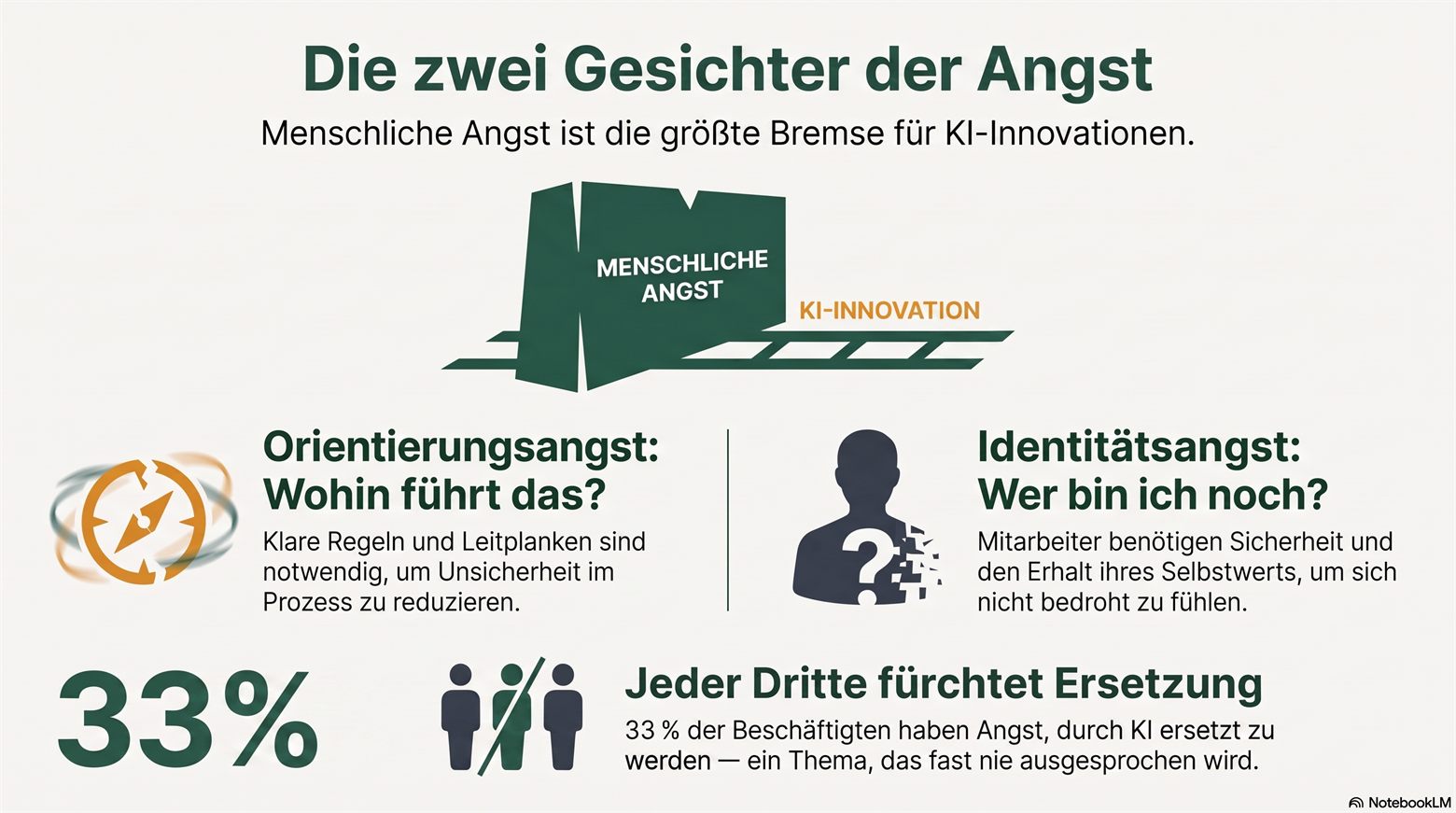
You have bought licences, provided tools, perhaps even held a kick-off. And then nothing happens. Or worse: one half uses AI in secret and without rules, the other half blocks it. According to Bitkom, one in three employees is afraid of AI, but very few talk about it. The problem: you only see the resistance once it is already slowing you down.
First I look at which fear I am facing. One is social fear: if it comes out that I did this with AI, I will be seen as lazy or replaceable. That is our core theme, this making yourself indispensable. I am afraid that AI will take over from me. No rule helps there, only certainty.
From our work alongside companies
This is not a feel-good exercise. It is the difference between AI projects that become productive and those that sink into the swamp of shadow IT. Christina Lange, organisational consultant with a focus on guiding change, confirms it: when employees are afraid, it is not a technology problem but a leadership issue. My experience shows the same, only more starkly. I can write down the cleanest governance, but if people are afraid, they will still use AI in secret. Then I have rules on paper and blind spots in reality.
The other fear is orientation fear: I do not know what I am allowed to do. That disappears with small guardrails, in other words governance. But social fear, the fear of being seen as replaceable, runs deeper. Dr. Eva Schulte, psychologist and leadership coach, adds an important nuance here: this is not only fear for your job, but identity fear. It is about self-worth, not about following rules. That is why rational policies do not work here.
How do you tell which fear you are facing? My test is simple: if people whisper about AI, it is a safety problem. If people ask out loud what the rules here actually are, and still nothing is done, then governance is missing. My order is therefore almost always the same: first the foundation, then the guardrails on top of it. Governance without a foundation does not hold.
Where healthy scepticism ends and paralysing fear begins
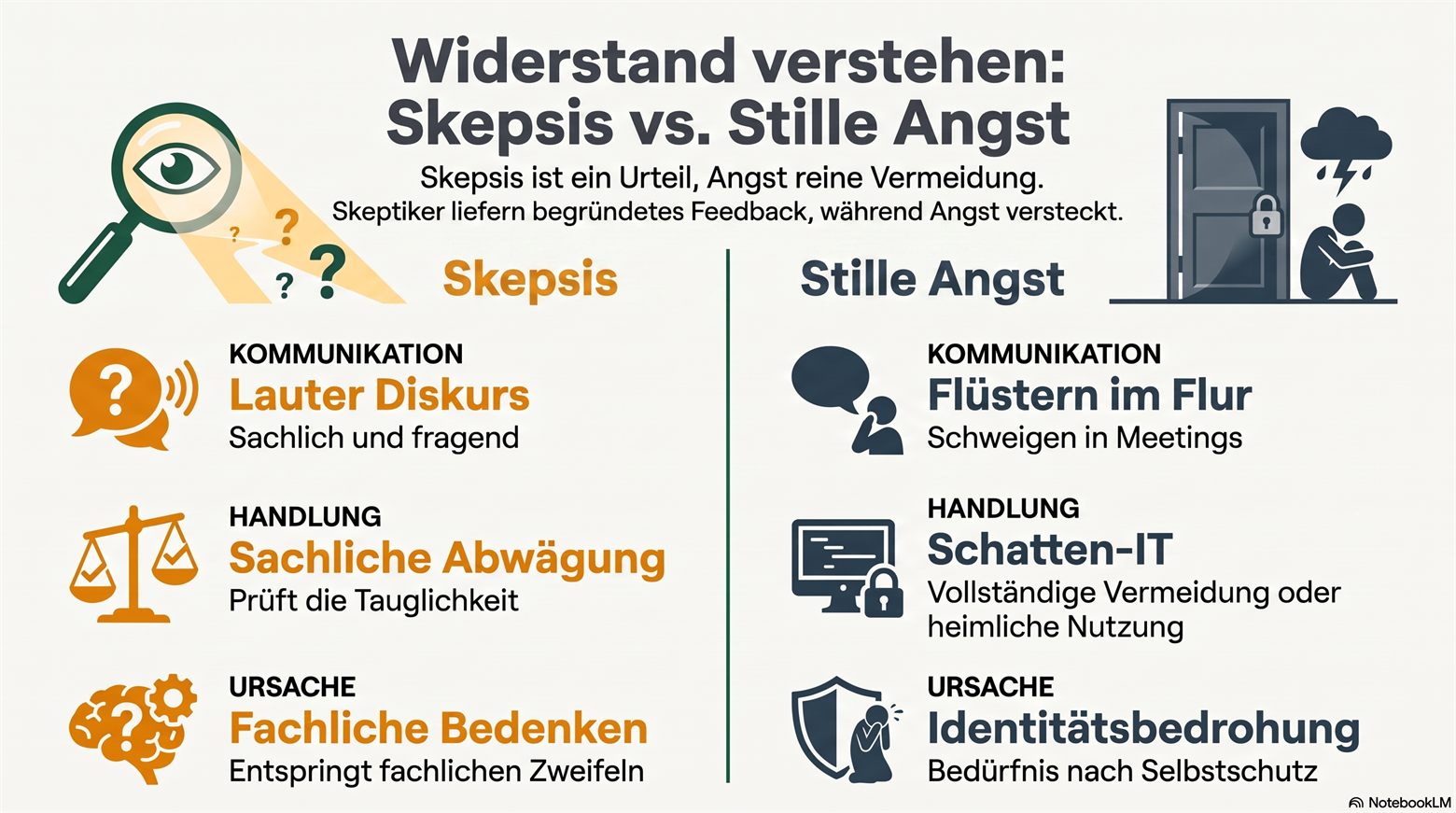
The line runs between judgement and avoidance. Healthy scepticism is a judgement: someone has looked at the tool and says, with reasons, "no, not here" or "not yet". That is valuable feedback, exactly the judgement you want in your team in order to get better.
Scepticism asks: "Is this any good? Does it suit us?" Fear, by contrast, does not even look. It does not ask whether the tool is any good, but: "What happens to me if I use this?" or "What happens if it comes out that I cannot do something and used AI for it?" That is not an assessment of the tool, but self-protection.
From our work alongside companies
The tipping point comes when the reluctance can no longer be explained. The sceptic can tell you why they hesitate. With fear, you get pretexts such as data protection, quality, no time or "I have not quite understood it yet". When you ask further, they do not stand up.
A second sign: nobody refuses openly, they quietly avoid. No "no", just no starting. You ask about the first pilot, and two weeks later nothing has happened. You get evasive answers instead of a clear refusal.
At that point at the latest, it has to be raised. You can talk scepticism through, but you cannot talk fear away. It needs certainty, otherwise it becomes culture. Then it is no longer the individual who blocks, but the whole company.
What successful leaders do differently: three steps before the first conversation about tools
You do not recognise unspoken fear by what is said, but by what is missing. AI is used, but never mentioned. It comes up in corridor conversations, but not in meetings. This is exactly where your task as managing director begins.
Step 1: Your example is the permission
Show, with your own examples, again and again that you use AI. Be transparent about it. Make clear that this is a good thing. This permission does not come from your announcement, but from your example. You do not have to be perfect. You have to be visible.
I do not recognise unspoken fear by what is said, but by what is missing. AI is used, but never mentioned. It comes up in corridor conversations, but not in meetings. Three steps for managing directors before it is about the tool: first, set an example yourself. Show, with your own examples, again and again that you use AI. Be transparent and make clear that this is a good thing. This permission comes from your example, not from your announcement.
From our work alongside companies
Step 2: Your reaction to mistakes changes everything
The first sentence in response to every AI mishap, every shared AI mistake: "Thank you for telling me." Only then move on to the practical level and think towards a solution. Making these mistakes visible at all is a huge step forward. Introduce formats: the AI mishap of the week, the worst prompt of the week. Lead by example here too.
Dr. Jonas Hartmann speaks of the need for clear statements on what AI is used for and what it is not, and for room for doubt and criticism (in German). This adds to my point on psychological safety through a changed approach to mistakes. Real learning begins only when mistakes are no longer a danger.
Step 3: Hand over the decision on quality
"How did the AI do here? Do we think it is good? Are we happy with it?" Hand these questions to the team, and do not remain the checkpoint yourself. That way you are no longer the bottleneck, and you enable the team to really dive into this decision. They will then, of course, engage with it far more intensively than if you kept the decision for yourself.
Only after that comes the conversation about tools. Only then does the question of licences make sense.
When training and pilot projects increase fear instead of reducing it
Most companies begin at the other end. They buy licences, train people on the tool and wonder why nothing happens. Why? Because they treat AI as a question of tools, when it is a question of stance.
The most common mistake is treating AI as a question of tools when it is a question of stance. Companies train people on the tool and not on how they work together. Afterwards everyone can use the tool, and still nothing happens, because nobody wants to show what they are doing.
From our work alongside companies
That is exactly the point. Training without psychological preparation fizzles out. Pilots without trust fail before the first prompt is typed. One half uses AI in secret without any policy, the other half blocks it completely. Both extremes show the same thing: fear is in the room, and nobody has addressed it.
The warning signs are almost always quiet. AI is mentioned now and then, but not discussed openly. It does not come up in meetings, but it does in corridor conversations. Results are presented without making clear whether and how AI was involved. Scepticism disguises itself as a factual argument, but when you ask further, it crumbles.
David Cavas sums up the counter-strategy: "Do not start with the tool, start with the problem. Whoever addresses the team's biggest pain point and turns it into a clear pilot project builds trust." (in German, translated here) The team's problem, not the management's tool, is the lever.
In short: if AI is used but not named, fear is in the room. And then every pilot is premature. Lay the ground first, then build.
Transparency vs. concealment: which communication strategy really builds trust
I am clearly on the side of transparency, but not the aimless kind. For me, leadership does not mean pretending you already have all the answers on AI. Nobody believes that anyway, and it creates exactly the pressure under which use goes into hiding.
But if you admit, "We are learning this together now", you give people permission to try things out. Your people see that the boss does not know everything either. And that is a good thing. Now it is fine for them to make mistakes, ask questions and experiment. Without this permission they use AI in secret or not at all, and both are bad for your company.
Being open about gaps in knowledge is not the same as being open about direction, though. The line runs exactly there: it is fine to be unsure about the route, never about where we are heading.
From our work alongside companies
"I do not yet know which tool is the right one", "I do not know the exact prompt", "I need to try this out": that builds trust. "I do not know where we are heading": that paralyses. Your people need a fixed point on the horizon, otherwise everyone drifts in a different direction.
So, once more: the direction is fixed, the route is open. On the goal you give certainty, and on the route you invite your employees to think things through with you. That is the agreement. And it works.
Specifically: tell your team which problem you want to solve with AI, such as better quotes or faster troubleshooting. But do not say exactly what the tool is called or what the process looks like. You work that out together. Transparency about uncertainty builds trust. Transparency about having no goal creates panic.
The specific first step: what you can do this week to make quiet fear visible
The first week belongs not to the team but to you. No workshop, no survey, no "We need to talk about AI". Instead, you bring a result of your own, something you made with AI. And then you simply say so.
Hey, this was made with AI. I was not sure whether that is okay, but it helped me and I think it is good.
Not as an announcement or a permission, but as a fact. You show that using AI can be out in the open and is not a secret topic. People can talk about it.
The quiet fear in your team does not dissolve when you ask, "What are you afraid of?" It dissolves when you are the first to show that it is okay to use AI, and that it is also okay to feel unsure while doing it. Every survey, every meeting, every workshop stays empty as long as you do not go first yourself.
That means you get into the boat too, with your own doubts and your own uncertainty. Not as a weakness, but as a signal: we are trying this out together. Nobody here has all the answers yet.
This is not AI adoption. This is leadership. And it begins not with strategy, but with visibility.
Researched and written by Laelia Platzer. AI tools were used in the research.